
- Convoy Ships -
“Campaign” is a type of battle typically played only
at the Annual Championship (NATS). From the IRCWCC rules: “The purpose of
Campaign is to recreate scenarios reminiscent of those conditions which naval
powers faced during the time period from 1905 to 1946 when they attempted to
attack or defend strategic land objectives. The safe passage of convoys and the
control of surrounding waters in a war zone were often the crucial factors in
the successful outcome of a campaign in war time. Campaign tries to simulate
those crucial times of difficult supply and sea control in a game which is easy
to play and highly enjoyable for all involved. The conditions being replicated
during Campaign include the maintenance of water borne supply lines while at
the same time trying to deny those lines to enemy forces. The fleets battle for
control of the sea lanes and receive points for successful convoy missions, and
the protection of troops and supplies on land.”
Essentially, the majority of the points in Campaign
are scored by completing convoy ship runs. Though conceptually simple and
requiring drive and rudder control alone, building a reliable convoy ship
requires the same level of attention that building a reliable warship requires.
Convoy ships are meant to have maneuverability disadvantages (they travel much
slower than fighting ships and have relatively small rudders especially on the
larger ships), so that they require protection and are more huntable by capital
ships. There are few resources on convoy ships, which is why I am writing this
article.
First, a few rules and other factors that should be
considered:
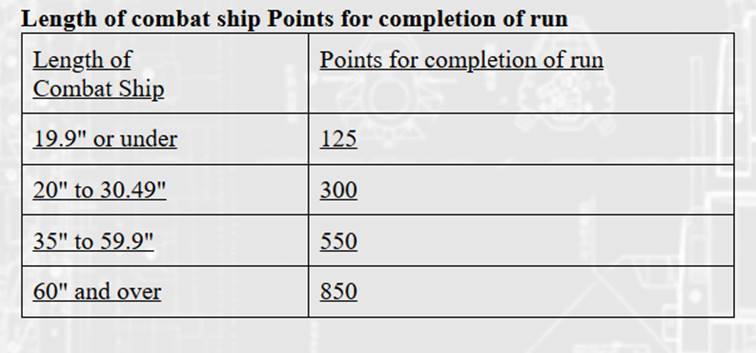
Convoy ship scoring: Convoy ships score various points for completing runs which scales
with ship length. The table below is scoring as of 2025. Each “run” is
completed by driving from one “port” to the other, while being on the water for
a minimum of 5 minutes. The first 30 seconds of which the ship is not a viable
target while it gains “sea room.”
Holes don’t matter: Holes in convoy ships (and for that matter combat ships) are not
counted and scored in campaign as they would be in a Fleet Battle. The only
thing that matters is whether the ship is able to complete a run or not. This
is important to keep in mind when attacking convoy ships. If you don’t think
you can realistically put enough holes in the ship to disrupt the run by
sinking it, then those shots might best be saved for a different target.
Another strategy, however, is to shoot ships to some degree, forcing them to
repair damage and thus slow down how fast it can cycle runs.
Sinks don’t matter: In the current rules, a convoy ship being sunk is not something that
negatively impacts scoring. It does make that run not completed of course and
prevents those potential points from counting. For the sake of transparency and
completeness, combat ship sinks do matter however and though similarly holes
are not counted or scored, the sink value of the ship is scored.
Speed:
Convoy ships are considerably slower than warships, all of which are only
allowed 34 seconds over a 100-foot course.
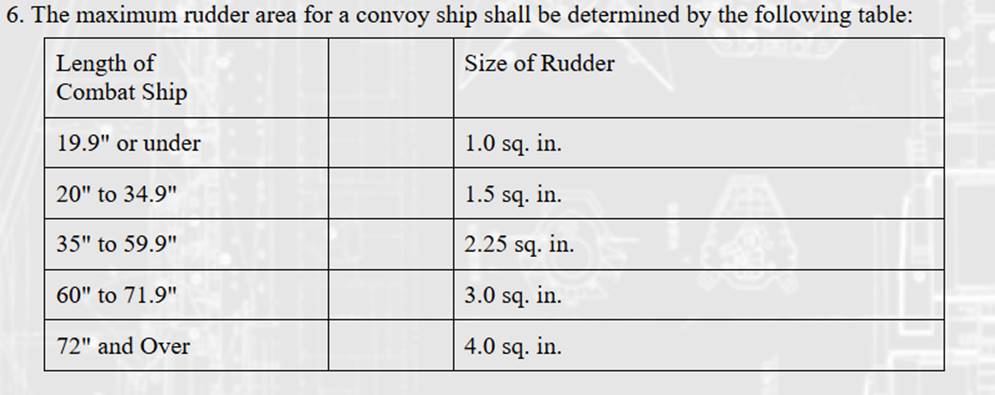
Rudders: Rudder size is determined by
length. Compared to warships the rudder size is considerably smaller. The table
below is as of 2025.
Ship
variety: Campaign provides for a wide
variety of different ships that otherwise would not be built within our hobby.
Aircraft carriers, oilers, hopsital ships, seaplane tenders, referigerator
ships are all not really viable combat ship, but can get on the water in
Campagin.
Observations: My observations regarding campaign
and building of convoy ships are as follows:
1. The very large convoy ships are
actually hard to sink in 5 mintues. Though there is typically significantly more
target area on convoy ships in the 60+ inch long range, the amount of reserve
buoyancy in these ships is large, and inflicting enough damage to put it down
is very difficult. Shooting these ships is wortwhile though as forcing them to
patch slows down the cycle time and decreases the total runs they will
complete. My advice when targeting these is always to try to spread damage out
so patching takes longer, and shoot it enough that they can’t just go for another
run without patching, but not enough that wastes all of your ammo.
2. The very small convoy ships are often
quite manuverable and difficult to put damage into, clearly however they are at
a disadvantage in terms of point scoring capacity. Some captains use the little
convoy ships to try to “touch” warships which in campaign forces them to come
to shore for 30 seconds. I have my own opinions about the honorability of this
tactic, especially when they target warships significantly outside of their own
vicinity.
3. Getting the convoy ship to sink level
is extremly important. This is where construction tecnhques matter. The ship
needs to be built so that it settles as evenly as possible both from front to
back and from side to side. Even if it barely limps its way back to port, if it
makes the run without decks awash, the points count. The placement of internal
components such as batteries and putting in effective water channeling can
significantly impact this. It really takes repeated sink testing and
adjustments to optimize level sinking.
4. Most convoy ships should be built as
light as possible with as much reserve buyancy as possible. Keeping
superstructure light helps. Usually, the penetrable area will extend to most of
the depth of the hull to maintain 1 inch below the water line/45 degree
compliant. Like all ships, if you can find a way to float the hull before you
build it out entirely, it will help determine where to cut the pennetrable windows
down to.
5. Single shaft convoy ships are at a
disadvantage in my opinion. The torqure roll of the single shaft in an
otherwise fairly light ship will all to easily cause the ship to settle with a
list as it sinks.
Hikawa Maru
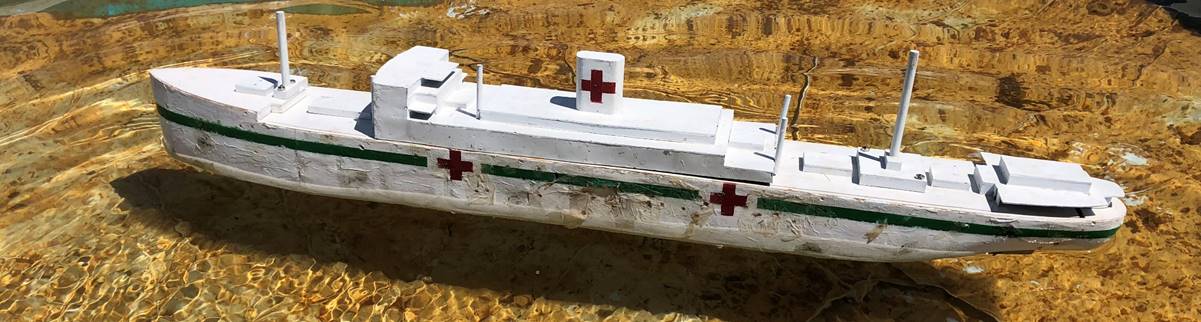
Seriously, who doesn’t want to shoot
the hospital ship?
Hikawa Maru
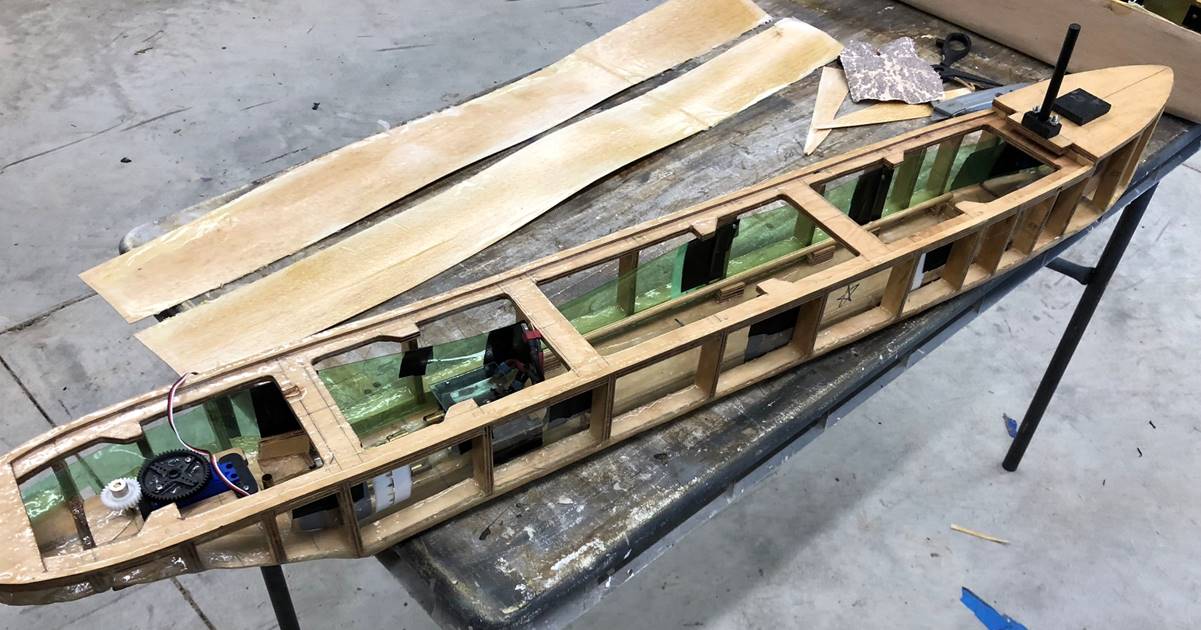
In my opinion, wood hulls are
superior for convoy ships because they do add some degree of buoyancy from the
wood itself that fiberglass hulls can’t. There are several important aspects of
convoy ship construction that you can see on this picture. The penetrable
windows are incredibly deep, going to either the 45 degree angle but at most
1/2 inch from the bottom of the hull in this model. Internal armor for my
convoy ships is always plastic soda bottles, strong but very light. The stern
has motors and rudder gear, that is about it. The rails along the middle of the
ship are for attaching Velcro to hold batteries in place. This ship can be
tipped upside down to dump out water and be placed right back on the water to
go again, which is a huge advantage in terms of keeping repeat convoy runs
cycling as fast as possible. I’ve found this ship to settle much more reliably
with the balsa bilge water channeling. Also, there is water channeling in the
extreme bow.
4 sisters
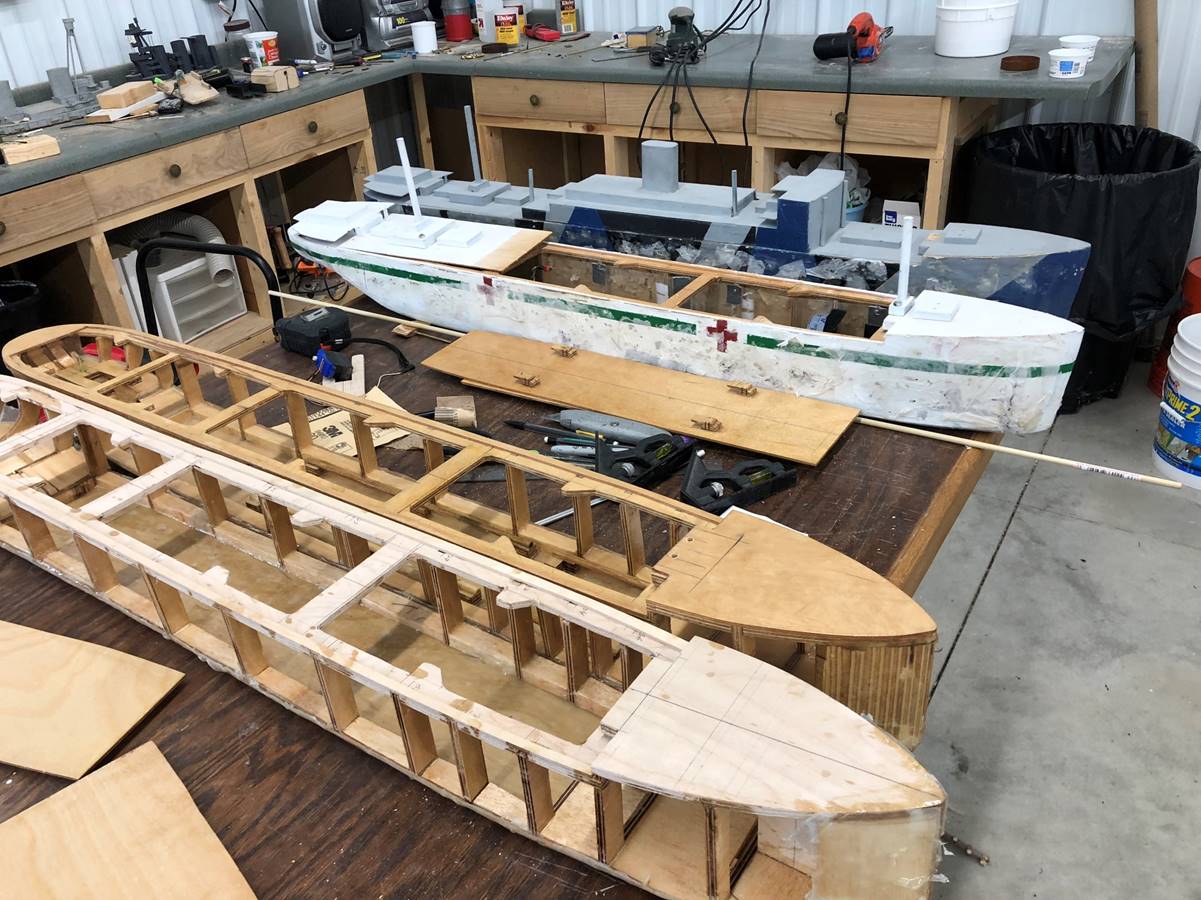
Under construction. I ended up
building 4 identical hulls because they were fairly reliable.
Hikawa Maru, Hie Maru, Heian Maru,
Hikawa Maru-2
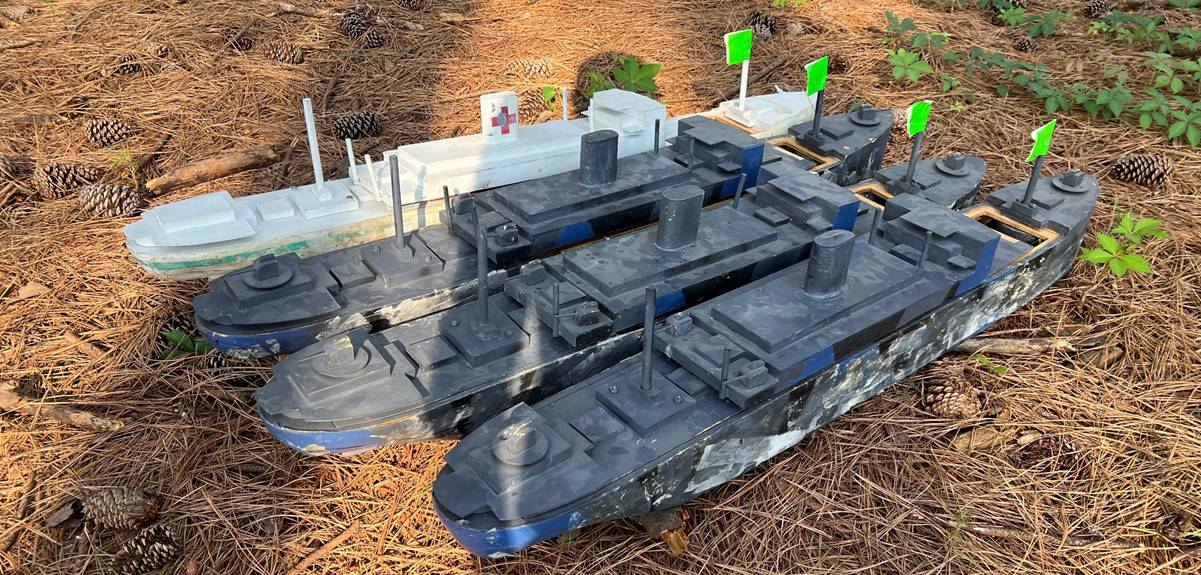
Having identical ships can make it
difficult for attackers to prioritize targets.
Akagi
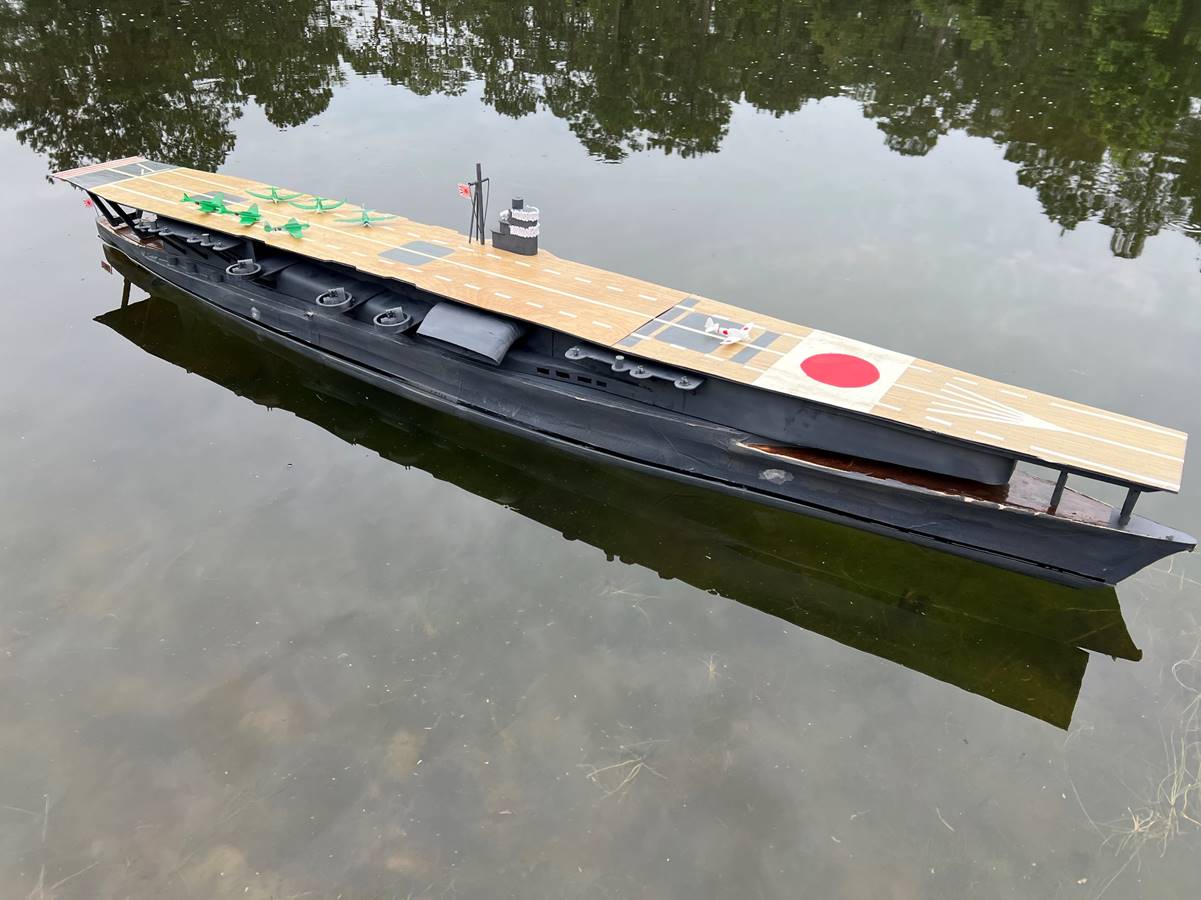
Big Beautiful Boat.
RMS Queen Mary
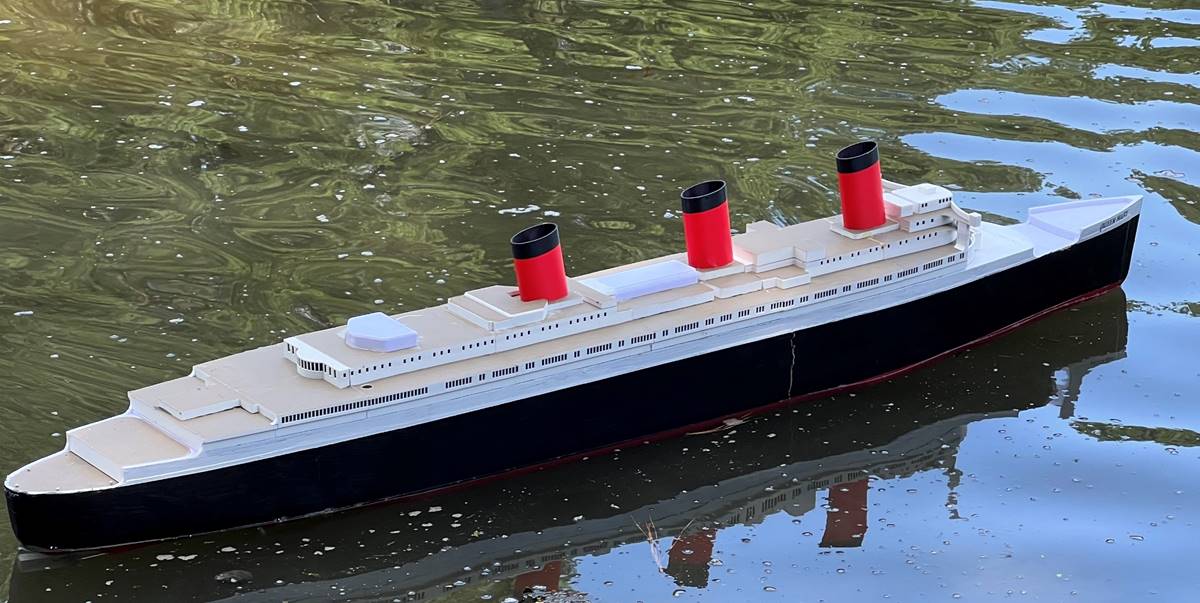
Will’s 1019 foot long (nearly 85
inches in scale) passanger liner. Actual billboards are jealous.
USS Saratoga
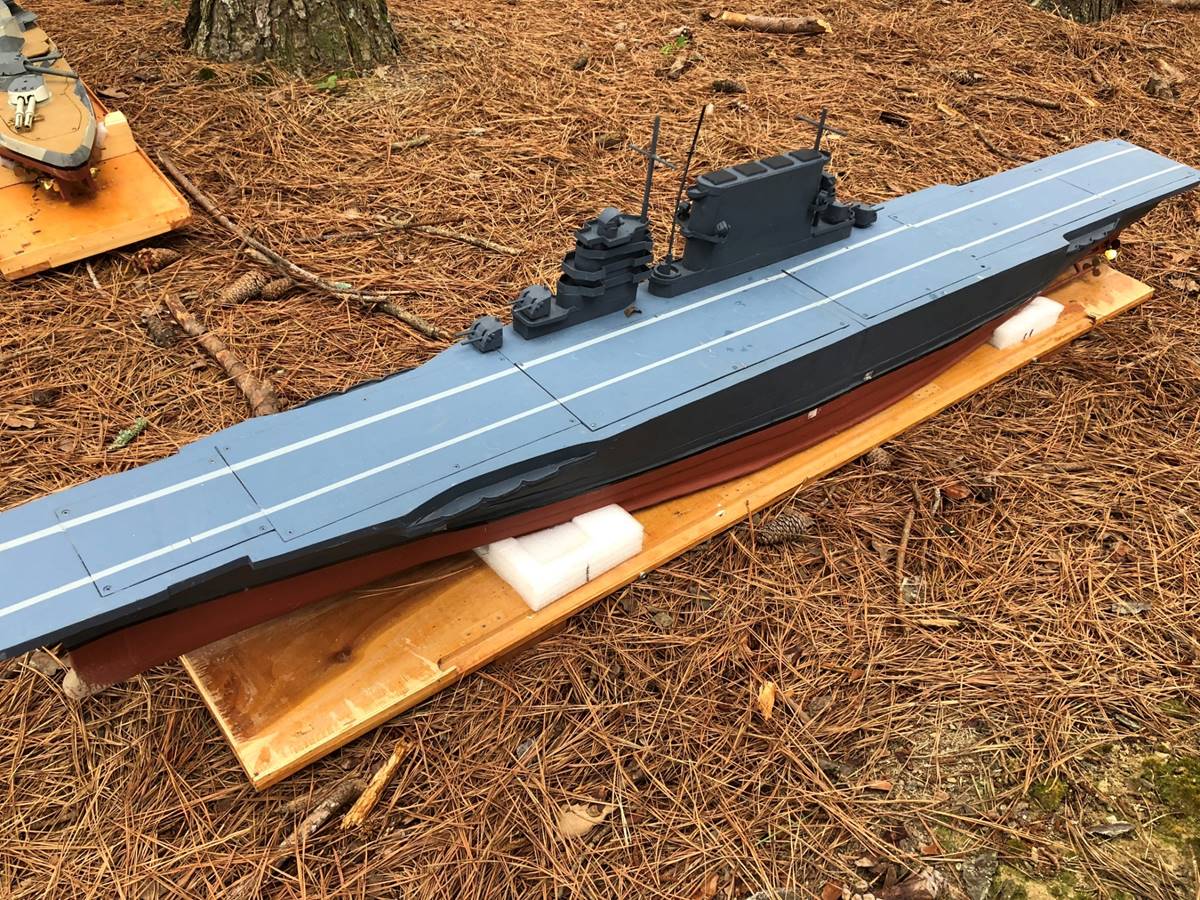
This thing has survived being run
over by a van. Tom spent a lot of energy making this ship reliable and it
typically runs endlessly in campaign.
USS Saratoga
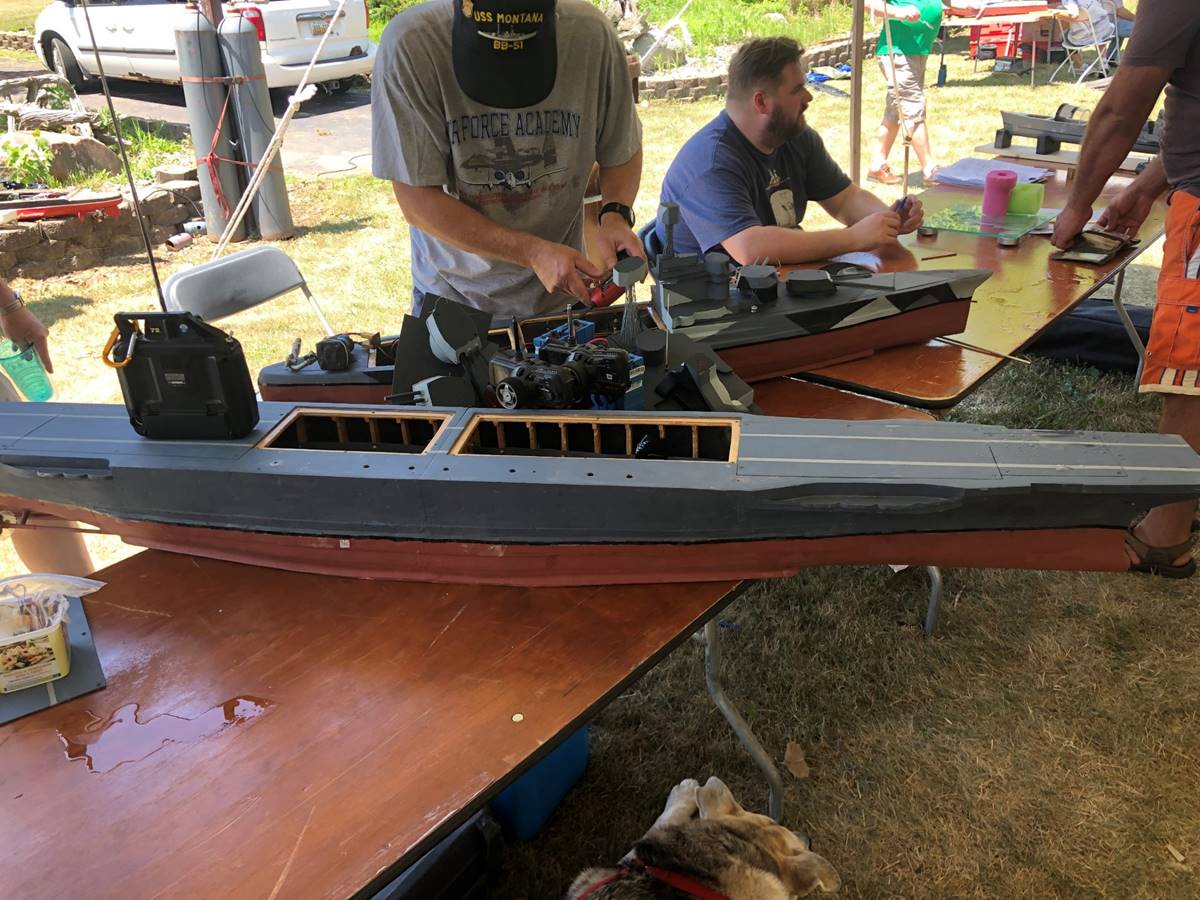
This thing is BIG!
Japanese Convoy ships
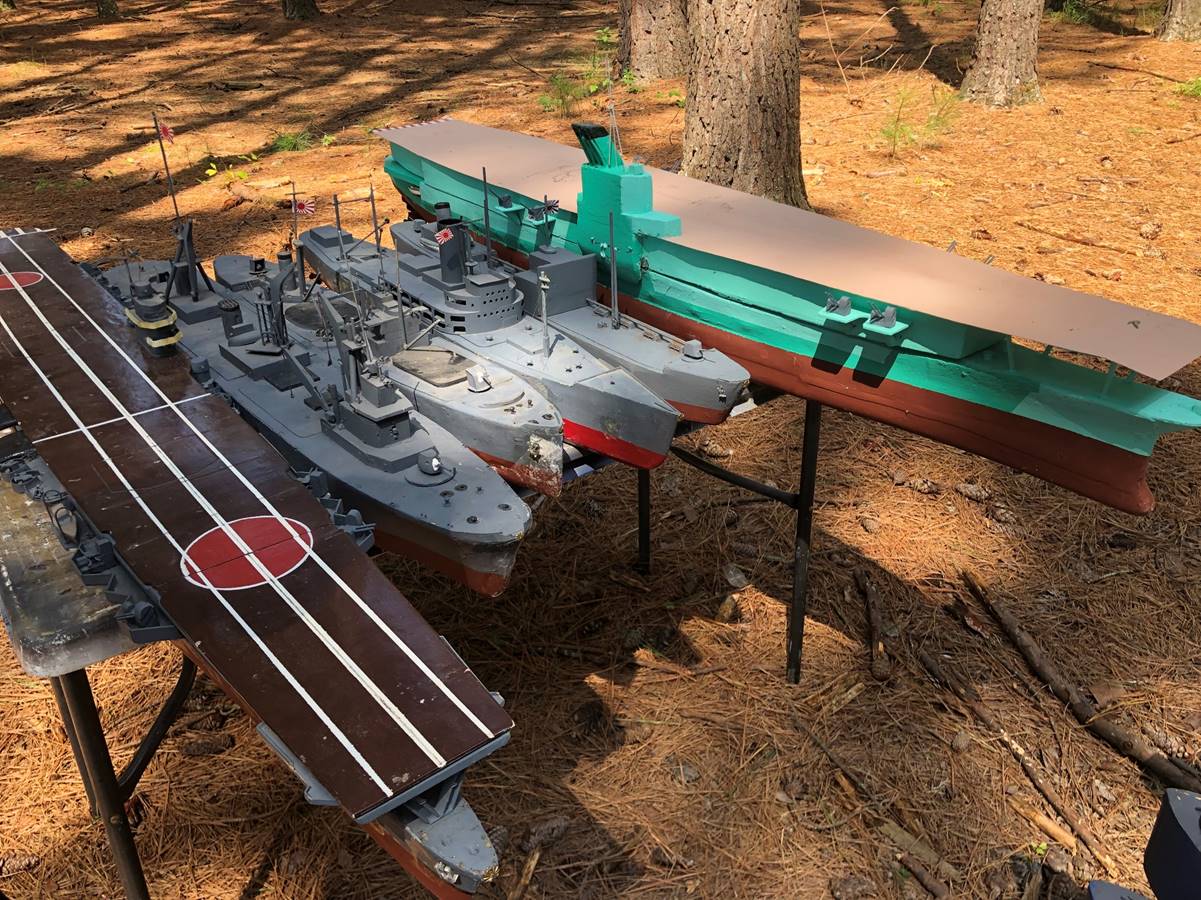
These are Jeff’s convoy ships.
Convoy ships with Kongo and Radetzky
for scale
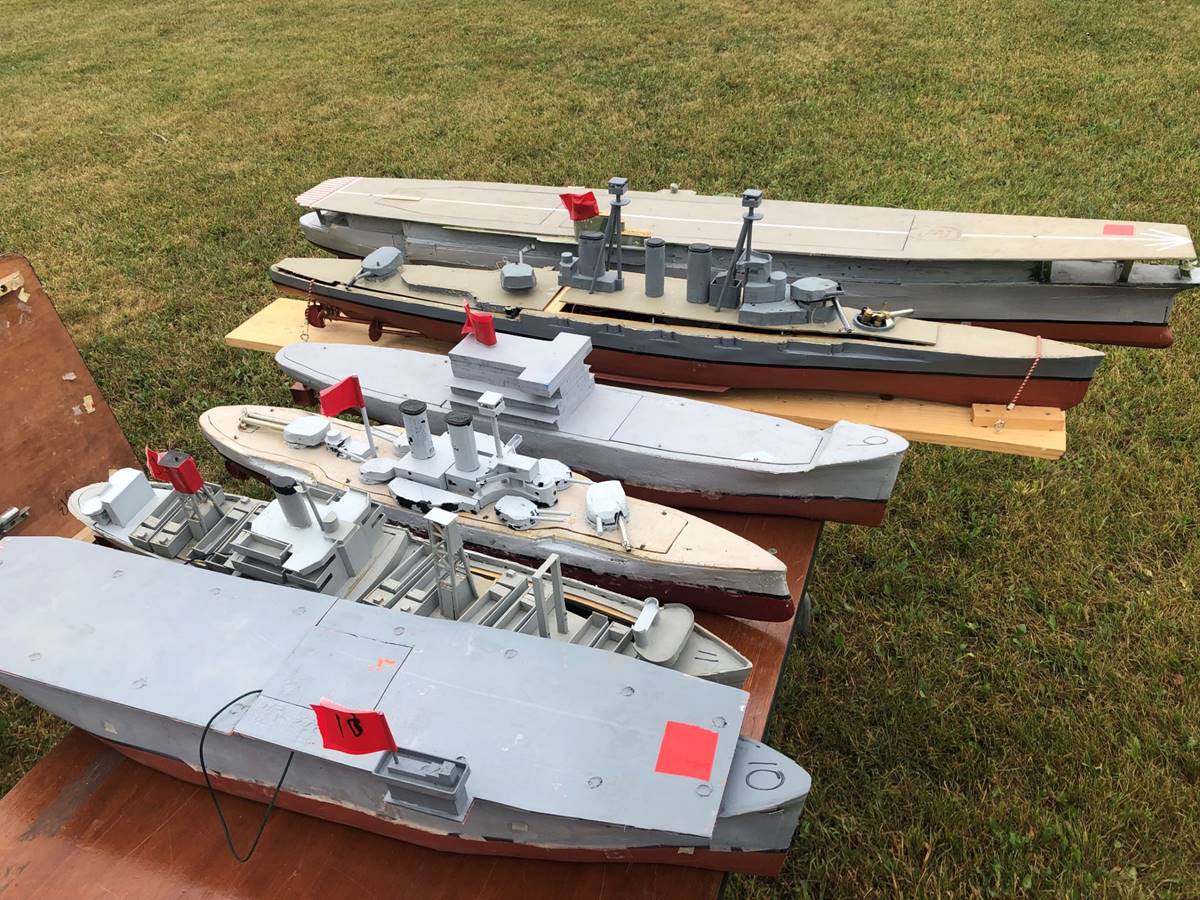
Kevin P’s convohy fleet.
US convoy ships
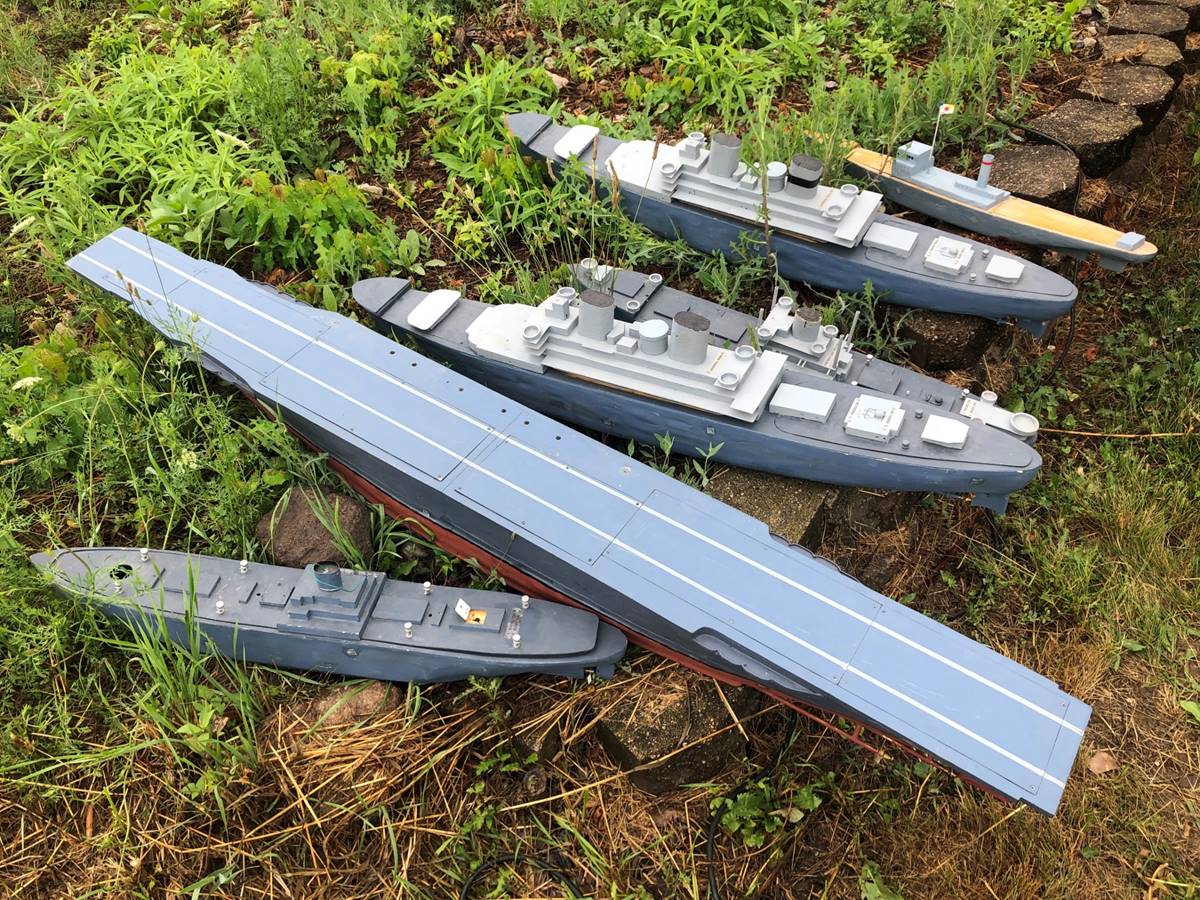
Tom P’s convoy fleet. With a tiny
Japanese tag along.
USS Saratoga
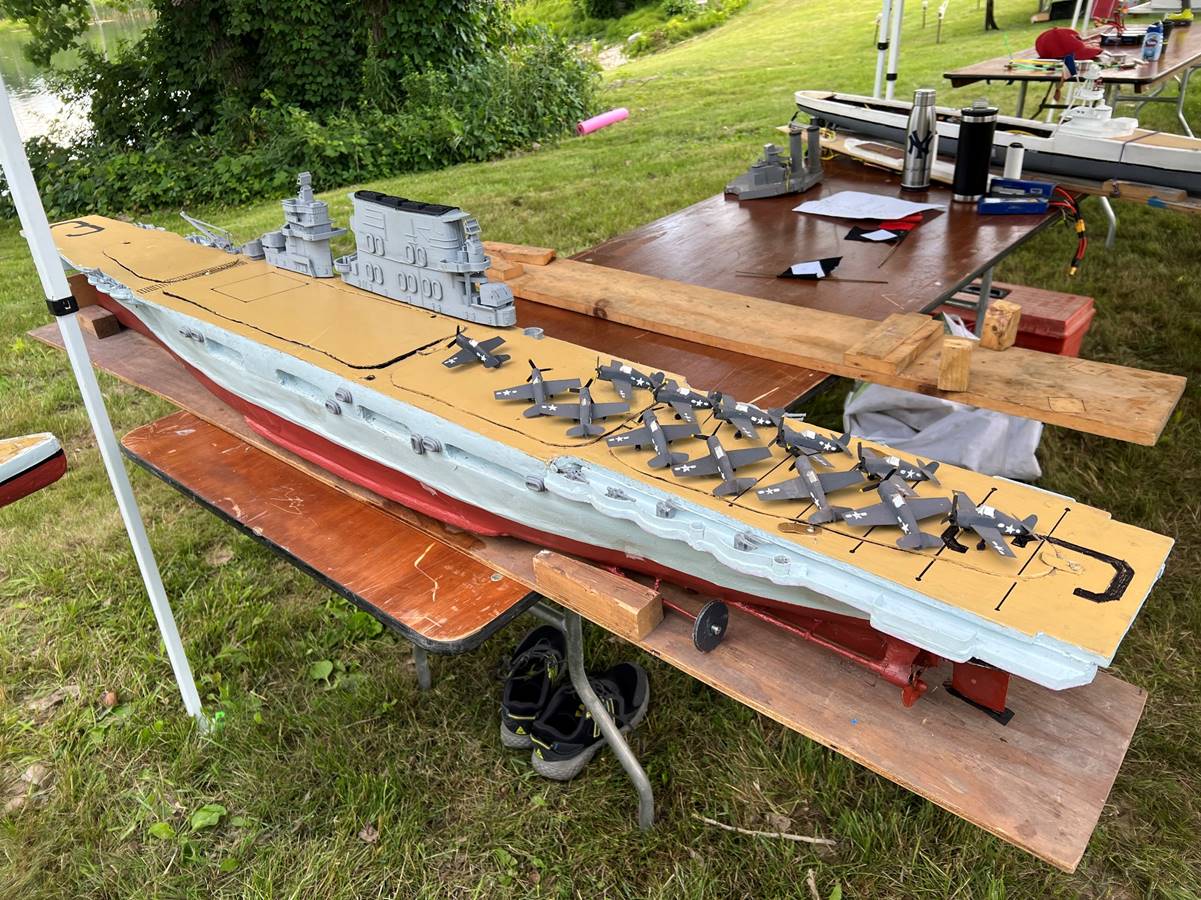
Best of scale convoy at this nats.
Tyler Helland, 7/19/2026